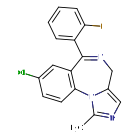
Milestone Pharmaceuticals Inc. (Nasdaq: MIST) announced the U.S. Food and Drug Administration (FDA) approved its first commercial product, Cardamyst (etripamil) nasal spray, a prescription medication for the conversion of acute symptomatic episodes of paroxysmal supraventricular tachycardia (PSVT) to sinus rhythm in adults. This approval marks the first time that more than two million Americans with PSVT will have a rapid-acting treatment option they can self-administer outside the emergency department or other healthcare setting. Cardamyst is expected to be available in retail pharmacies in the first quarter of 2026.

Cardamyst nasal spray is a novel and rapid-acting calcium channel blocker delivered when needed to treat often highly symptomatic and unpredictable episodes of PSVT. With Cardamyst, adults with PSVT can be prepared wherever and whenever episodes occur, providing them with active management and a greater sense of control of their condition.
“Cardamyst is a novel at-the-ready treatment option that addresses the unpredictable impact of PSVT by offering patients the freedom to manage episodes anytime and anywhere,” said Joseph Oliveto, President and Chief Executive Officer of Milestone Pharmaceuticals. “The FDA approval of Cardamyst is a watershed moment for Milestone and a gratifying event for our team members, patients, clinical investigators, and health care providers who participated in the development program, all of whom I sincerely thank for their dedication, counsel, and collaboration toward this important achievement.”
“Some people with PSVT have endured years of anxiety, fearing their next episode and the stress and disruption of emergency department visits,” said James Ip, M.D., FACC, FHRS, an etripamil investigator. “Cardamyst will give many of them the ability to administer a medication themselves that can quickly stop their PSVT episode and potentially avoid a hospital trip or a call to emergency services.”
Cardamyst Clinical Data
The FDA approval of Cardamyst is supported by a robust clinical trial program based on safety data from more than 1,800 participants and more than 2,000 episodes of PSVT. This includes the successful Phase 3 RAPID trial, a global, randomized, double-blind comparison of Cardamyst vs. placebo, published in The Lancet in 2023. In clinical studies, participants using Cardamyst were two times more likely to convert symptomatic PSVT to sinus rhythm and did so more than three times faster compared with placebo. The RAPID trial achieved its primary endpoint with 64% of those who self-administered Cardamyst (N=99) converting from supraventricular tachycardia (SVT) to sinus rhythm within 30 minutes compared to 31% on placebo (N=85) (HR = 2.62; p<0.001). At one hour, the benefit was demonstrated in 73% of participants. In addition, significant reductions in time to conversion in those who took Cardamyst were evident early and durable, with a median time to conversion of 17 minutes (95% CI: 13.4, 26.5) for those treated with Cardamyst vs. 54 minutes (95% CI: 38.7, 87.3) for those treated with placebo.
A consistent safety profile and treatment effects were observed across all subgroups, including participants concurrently on beta blockers or calcium channel blockers. The most frequent adverse events occurring in ≥5% of participants in randomized clinical trials were mild-to-moderate and transient in nature, including local-site nasal discomfort, nasal congestion, rhinorrhea, throat irritation, and epistaxis. Less than 2% of trial participants discontinued therapy due to adverse events.
For more safety information about Cardamyst, please see Important Safety Information below. For the latest information about the product availability, please see https://milestonepharma.com/.
PSVT, also called SVT, is characterized by episodes of abnormally fast heart rate. Most people with PSVT experience multiple sustained episodes that require treatment on an annual basis. Until now, successful treatment options typically required IV administration in healthcare settings, creating stress and costs for patients and their insurers. Cardamyst offers a new approach to treat episodes of PSVT, enabling adults to self-administer the medication at the onset of symptoms. For more information, please visit SVTHearttoHeart.com.
“Our goal is that Cardamyst will become a trusted and essential solution for healthcare providers and their patients,” said Lorenz Muller, Chief Commercial Officer of Milestone. “Our team is focused on making Cardamyst available to adults with PSVT as quickly as possible, including actively working to secure insurance coverage and begin the distribution of the product through retail pharmacies.”
Annette Greene, Cardamyst clinical trial participant and administrator of the Supraventricular Tachycardia Group on Facebook, with more than 30,000 members, said, “Adults with SVT have been waiting a long time for the day when they can confidently self-administer Cardamyst to treat their SVT episodes. It is very exciting that the day has become a reality.”
Regarding future R&D, Milestone is poised to enter a Phase 3 program in atrial fibrillation with rapid ventricular rate (AFib-RVR), particularly on the strength of the successful ReVeRA Phase 2 trial in AFib-RVR, results of which were published in Circulation: Arrhythmia and Electrophysiology. Incorporating FDA’s guidance, Milestone has developed a Phase 3 registrational program to evaluate self-administered etripamil as a potential treatment for patients with AFib-RVR. When completed, the Company will be following a supplemental New Drug Application (sNDA) regulatory approval pathway for a potential second indication for etripamil in AFib-RVR. As such, Milestone will leverage the approved PSVT indication and the PSVT program data, along with a single pivotal Phase 3 study in patients with AFib-RVR.
https://en.wikipedia.org/wiki/Etripamil