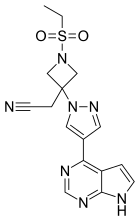
In coninuation of my update on Baricitinib
Baricitinib had a significant glucocorticoid (GC)-sparing effect in people with newly diagnosed polymyalgia rheumatica (PMR), who participated in the phase 3 JAK-Spare trial, was according to results reported at the European Alliance of Associations for Rheumatology (EULAR) 2026 Annual Meeting.

GC-free remission at week 16 was achieved in nearly two thirds (65.2%) of the 23 people who had received the drug in the trial, as compared to 17.4% of the 23 people who had been treated with placebo (P < .01).
And when participants who had initially been treated with placebo crossed over to treatment with baricitinib, their GC-free remission rate at week 28 increased to 65.2%. The GC-free remission rate in the baricitinib arm also increased to 78.3%.
Baricitinib is a drug that is “efficacious and safe in many of our [rheumatic and musculoskeletal] diseases. We know the mechanism, we know the safety profile, and therefore, it also makes sense to also test this drug in this patient population,” Lechner-Radner added.
The JAK-Spare Study
The JAK-Spare study involved 46 people with recently diagnosed PMR who were recruited between July 2022 and May 2024 across five European centers. The mean age of the recruited participants was 65 years, just over half were men, and all were White.
Participants were randomly allocated to receive baricitinib 4 mg/d or to a placebo. A rapid GC-tapering regimen was used in both arms, which aimed to reduce the dose of GCs to zero within 11 weeks rather than the usual 52 weeks. After the initial 16-week study period, patients in the placebo group crossed over to treatment with baricitinib, while those in the baricitinib arm continued treatment. Then at 28 weeks, participants in GC-free remission were randomly assigned again either to continue baricitinib 4 mg/d through week 44 or lower their dose of baricitinib to 2 mg/d, stopping it altogether from 36 to 44 weeks.
Lechner-Radner said in an interview that GCs were given from the outset in the trial in both treatment arms because the investigators felt that it would not have been ethical to give patients newly diagnosed with PMR no treatment at all.
The time to relapse was significantly longer with baricitinib than placebo (P = .008). Participants in the baricitinib arm also took a lower median cumulative GC dose than those in the placebo group, at 736 mg vs 1065 mg at 16 weeks (P = .015) and 736 mg vs 1086 mg at 28 weeks (P = .013).
After re-randomization of the 33 patients who were in GC-free remission at 28 weeks, GC-free remission continued out to 44 weeks in 93.3% of those still taking baricitinib 4 mg/d and in 72.2% of those who tapered to 2 mg/d and then 0 mg/d (P = .186). Flare-free survival was higher among people who continued to take baricitinib 4 mg/d but was not statistically significant from those who tapered and then stopped baricitinib.
In each phase of the study, the percentages of participants with at least one adverse event were similar between the groups, at 87% in both in the first phase, 60.9% with baricitinib 4 mg/d vs 43.5% in the placebo crossover in the second phase, and 80% with baricitinib 4 mg/d vs 66.7% in those who tapered baricitinib in the third phase.
New Steroid-Sparing Option in PMR?
“With PMR, one wants to get patients off steroids as quickly as possible. Steroid therapy is quite toxic, and this is minimized by short duration of use and at a low dose,” Jonathan Kay, MD, professor of medicine and population and quantitative health sciences and the Timothy S. and Elaine L. Peterson Chair in Rheumatology at the UMass Chan Medical School in Worcester, Massachusetts, told Medscape Medical News. He was not involved in the trial.
But “if you can get someone on a medication that has less likelihood of causing toxicity than the steroid, the better that is going to be for the patient,” he added.
While these were positive data for a JAK inhibitor, Kay wondered whether such a drug would be likely to gain approval for use in this indication from regulatory authorities.
Kay pointed out that the interleukin 6 inhibitor sarilumab, which is given by subcutaneous injection every 2 weeks, is already approved to treat PMR.