Showing posts with label Experimental drug. Show all posts

Thursday, August 27, 2026

Experimental drug cuts Parkinson's-linked protein up to 60% in early trial

An experimental drug designed to silence a gene strongly linked to Parkinson's disease has shown encouraging effects in a first-in-human clinical trial, according to a study published in Nature Medicine. The drug, known as   BIIB094 (ION859), an antisense oligonucleotide targets LRRK2, the most common genetic contributor to Parkinson's disease; variants in LRRK2 are known to increase the risk of developing the neurodegenerative disorder, which affects nearly 10 million people worldwide

Scientists have long believed that lowering the activity of the LRRK2 protein could help slow or modify the disease, but turning that idea into a viable therapy has remained a challenge, said co-author of the study Danielle Larson, MD, '15, '18 GME, assistant professor in the Ken & Ruth Davee Department of Neurology's Division of Movement Disorders.

"This was a multicenter clinical trial looking at an antisense oligonucleotide therapy for LRRK2-specific Parkinson's disease," Larson said. "The main goal was to examine the safety of delivering this therapy to patients, with the hope that if it proved safe, future studies could evaluate whether it might slow disease progression."

The study tested whether BIIB094 could safely reduce LRRK2 levels in people with Parkinson's disease. The results suggest it can be done without serious safety concerns, Larson said.

In the randomized, placebo-controlled trial, 82 participants with Parkinson's disease were enrolled across two study segments. In the first, 40 participants received a single dose of BIIB094 or placebo. In the second, 42 participants received four doses of the drug or placebo, administered every four weeks. The therapy was delivered intrathecally: directly into the cerebrospinal fluid through a lumbar puncture.

Participants in the second section were stratified based on whether they carried a known LRRK2 genetic variant.

Across both parts of the trial, the treatment was generally well tolerated. While adverse events were common, they were mostly mild to moderate and did not limit dosing. No serious adverse events related to BIIB094 were reported, according to the study.

Beyond safety, the study provided strong evidence that BIIB094 hit its intended biological target. Analysis of cerebrospinal fluid showed that levels of LRRK2 protein fell by as much as 59% in treated participants.

These reductions were observed regardless of whether patients carried a known LRRK2 mutation, suggesting the therapy could potentially affect a broader group of Parkinson's patients, not just those with a genetic diagnosis, Larson said.

"The antisense oligonucleotide was designed specifically to reduce LRRK2 expression," Larson said. "Because overactivity of this protein kinase is thought to be part of the problem in Parkinson's disease, reducing LRRK2 levels could be protective and potentially modify the disease."

The new findings hint at a possible mechanism by which LRRK2-targeting therapies could influence the underlying disease process, rather than simply addressing symptoms, Larson said.

However, Larson cautioned that the trial was not designed to assess clinical benefits such as changes in movement, cognition, or disease progression. Larger and longer studies will be needed to determine whether reducing LRRK2 levels translates into meaningful improvements for patients.

"The next step would be a phase 2 study with a larger group of patients," Larson said. "Instead of focusing only on safety, those trials would look at efficacy, whether the therapy can slow disease progression using motor assessments and standard Parkinson's rating scales."

The findings mark an important step toward targeted treatments that address the root biology of Parkinson's disease and underscore the potential of BIIB094 and other precision-medicine approaches, Larson said.

"This is one of the first antisense oligonucleotide, or ASO, therapies in Parkinson's disease to have safety and tolerability data," Larson said. "It really paves the way for other ASO-based treatments to be developed, potentially targeting different biological pathways."

https://www.nature.com/articles/s41591-026-04262-4

Saturday, December 21, 2019

Experimental Drug, Voxelotor, Shows Early Promise Against Sickle Cell Disease

Voxelotor.png


An experimental drug for sickle cell disease reduced anemia and boosted the health of red blood cells in patients, according to a new study.
Whether the drug, voxelotor, will have long-term health benefits to patients remains to be seen.
But if approved for use by the U.S. Food and Drug Administration, "people living with sickle cell disease might have a new, once daily, tolerable oral medication that increases their hemoglobin level in the near future," noted Dr. Banu Aygun, who wasn't involved in the new trial.
She is associate chief of hematology at Cohen Children's Medical Center in New Hyde Park, N.Y.
As Aygun explained, sickle cell disease is an inherited blood disorder affecting more than 100,000 Americans. Black Americans, especially, are prone to the illness.
"The disease is the result of a change in a single gene leading to the production of an abnormal hemoglobin called sickle hemoglobin [HbS]," Aygun said.
"Due to this abnormal hemoglobin, red blood cells take the shape of a sickle and die much sooner than normal red blood cells. The sickle cells block small blood vessels, causing pain and affecting many organs throughout the body, leading to premature death," she said.
Right now, patients with sickle cell -- many of them children -- have few treatment options. "So far, there are only two FDA-approved drugs for sickle cell disease: hydroxyurea and glutamine," Aygun noted.
The new 17-month, phase 3 clinical trial was designed to see if a third treatment might be on the horizon. It was funded by voxelotor's maker, Global Blood Therapeutics, and included 274 patients, ages 12 to 65, in 12 countries.
Patients were divided into three groups that received either a 900-mg or 1,500-mg daily dose of the drug voxelotor, or a "dummy" placebo pill.
The study found that 51% of patients who took the higher dose of voxelotor had a significant increase in their hemoglobin levels after six months of treatment, compared with 7% of those who received the placebo.
Another finding was that 41% of patients who took the higher dose of the drug reached hemoglobin levels of more than 10g/dl at 24 weeks. A normal, non-anemic hemoglobin count ranges between 11.5 to 17.5 g/dl, depending on age and gender, the study authors noted.
"Chronic organ failure, which is predicted by the severity of anemia, is a leading cause of death for patients with sickle cell disease," said study lead researcher Dr. Elliott Vichinsky, a professor at the University of California, San Francisco.
"These patients are susceptible to strokes, renal failure and other complications that lead to early death," he said in a UCSF news release. "We believe this drug has the potential to decrease chronic organ failure in patients with this condition."
For her part, Aygun said the new drug does seem to hold promise, but gains for patients were so far not dramatic.
She noted that patient pain "events" didn't change, regardless of whether people received voxelotor or the placebo. The most common side effects with the new drug were headache and diarrhea.
And Aygun stressed that it remains to be seen "whether taking this medication for longer duration will lead to a decrease in pain events or organ damage caused by sickle cell disease."
https://pubchem.ncbi.nlm.nih.gov/compound/Voxelotor#section=2D-Structure
https://en.wikipedia.org/wiki/Voxelotor


Friday, June 30, 2017

Experimental drug may prevent development of multiple sclerosis in mice

The experimental drug laquinimod may prevent the development or reduce the progression of multiple sclerosis (MS) in mice, according to research published in the September 21, 2016, online issue of Neurology® Neuroimmunology & Neuroinflammation, a medical journal of the American Academy of Neurology.

Laquinimod.svg

"These results are promising because they provide hope for people with progressive MS, an advanced version of the disease for which there is currently no treatment," said study author Scott Zamvil, MD, PhD, of the University of California, San Francisco and a Fellow of the American Academy of Neurology.

In a proper immune response, T cells and B cells help the body develop immunity to prevent infection. But in MS, an immune and neurodegenerative disorder, those cells can help create antibodies that attack and destroy myelin, the protective, fatty sheath that insulates nerves in the brain and spinal cord.

For this research, the investigators studied mice that develop a spontaneous form of MS. Mice were either given daily oral laquinimod or a placebo (water). The number of T cells and B cells were then examined.

In one study of 50 mice, only 29 percent of the mice given oral laquinimod developed MS as opposed to 58 percent of the mice given the placebo, evidence the drug may prevent MS. Plus, there was a 96-percent reduction in harmful clusters of B cells called meningeal B cell aggregates. In people, such clusters are found only in those with progressive MS.

In a second study of 22 mice, researchers gave laquinimod after mice developed paralysis and observed a reduction in progression of the disease. When compared to the control, mice given the drug showed a 49-percent reduction in dendritic cells that help create special T cells called T follicular helper cells, a 46-percent reduction in those T cells and a 60-percent reduction in harmful antibodies.

"This study has given us more insight into how laquinimod works," Zamvil said. "But because this was an animal study, more research needs to be done before we know if it could have similar results in people."

Friday, October 7, 2016

Experimental drug ozanimod moderately effective in treatment of ulcerative colitis


Ozanimod.svg


Researchers at University of California San Diego School of Medicine have shown that ozanimod (RPC1063), a novel drug molecule, is moderately effective in the treatment of ulcerative colitis. Results of the Phase II clinical trial will appear in the May 5 issue of theNew England Journal of Medicine.

"This new class of immunotherapy drug traps white blood cells in the lymph nodes to prevent their escape into the gut where they cause inflammation," said William J. Sandborn, MD, professor of medicine at UC San Diego School of Medicine and director of the Inflammatory Bowel Disease Center at UC San Diego Health. "In addition to inducing remission in patients, the experimental drug reduced rectal bleeding and healed the mucosal lining of the intestine."

Ulcerative colits is a debilitating autoimmune disease that causes chronic diarrhea. One of the disease's defining characteristics is an abnormal accumulation of lymphocytes or T-cells in the lining of the gut. This activation of immune cells causes inflammation resulting in chronic, painful bowel movements. To counter this activity, ozanimod, a sphingosime 1-phospahte receptor modulator, halts the body's ability to recruit cells for an immune response.

"A one milligram pill of the drug induced clinical remission at week eight," said Sandborn. "Unlike other currently available drugs for inflammatory bowel disease, ozanimod can be orally administered and does not suppress the immune system to the point of increasing likelihood of infection or cancer."
Patients in the study were randomized to ozanimod 0.5 mg, 1.0 mg, or placebo. The most common side effects were anemia and headache.

Other symptoms of ulcerative colitis include intestinal bleeding and weight loss. Bowel obstruction, colon cancer, and malnutrition can also occur, resulting in hospitalization and the possible need for surgical removal of portions of the bowel and colon.

Ref : https://health.ucsd.edu/news/releases/Pages/2016-05-04-ozanimod-effective-for-treating-ulcerative-colitis.aspx

Tuesday, August 23, 2016

Experimental drug cancels effect from key intellectual disability gene in mice.


A University of Wisconsin-Madison researcher who studies the most common genetic intellectual disability has used an experimental drug to reverse -- in mice -- damage from the mutation that causes the syndrome.
The condition, called fragile X, has devastating effects on intellectual abilities.

Fragile X affects one boy in 4,000 and one girl in 7,000. It is caused by a mutation in a gene that fails to make the protein FMRP. In 2011, Xinyu Zhao, a professor of neuroscience, showed that deleting the gene that makes FMRP in a region of the brain that is essential to memory formation caused memory deficits in mice that mirror human fragile X.
The deletions specifically affected neural stem cells and the new neurons that they form in the hippocampus.
Tantalizingly, Zhao's 2011 study showed that reactivating production of FMRP in new neurons could restore the formation of new memories in the mice. But what remained unclear was exactly how the absence of FMRP was blocking neuron formation, and whether there was any practical way to avert the resulting disability.
Now, in a study published on April 27 in Science Translational Medicine, Zhao and her colleagues at the Waisman Center at UW-Madison have detailed new steps in the complex chain reaction that starts with the loss of FMRP and ends up with mice that cannot remember what they had recently been sniffing.
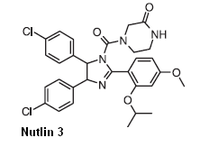
This study's newfound understanding of the biochemical chain of events became the basis for identifying an experimental cancer drug called Nutlin-3, which blocks the reaction.
In the new study, mice with the FMRP deletion took Nutlin-3 for two weeks. When tested four weeks later, they regained the ability to remember what they had seen -- and smelled -- in their first visit to a test chamber.

Nutlin3.PNG

Statistically, the memory capacities of normal mice and fragile X models that were treated with Nutlin-3 were identical.
Still, many hurdles remain before the advance can be tested on human patients, Zhao says. "We are a long way from declaring a cure for fragile X, but these results are promising."
Fragile X appears after birth, says Zhao. "Parents start to notice something is wrong, but even if they get an accurate diagnosis, there is no treatment at present. I'm encouraged because affecting this gene's pathway does seem to reverse the memory impairment."
The mouse memory test relied on curiosity. "We placed two objects in an enclosure and let the mice run around," Zhao says. "Mice are naturally curious, so they explore and sniff each one. We take them out after 10 minutes, replace one object with a different one, wait 24 hours and put the mouse back in. If the mouse has normal learning ability, it will recognize the new object and spend more time with it. Mice without the FMRP gene don't remember the old object, so they spend a similar amount of time on each one."
The behavioral assessment was done by different people, says Zhao. "First author Yue Li, a postdoctoral researcher at Waisman, ran the test and sent the video to Michael Stockton, an undergraduate working on the project." Stockton timed how and where each mouse was exploring, "but he had no idea which mouse was which," Zhao says. "It was fantastic to see such clear data."
Two other undergraduates, Jessica Miller and Ismat Bhuiyan (who is now in graduate school) and postdoctoral fellows Brian Eisinger and Yu Gao also worked on the study. The Wisconsin Alumni Research Foundation has applied for a patent on the discovery.
Nutlin-3, which can block the last stage of the chain reaction set off by a mutation in the FMRP gene, is in phase 1 trial for the treatment of the eye cancer retinoblastoma. Finding a new use for a drug that is approved, or that like Nutlin-3 and several derivatives, has entered the approval process, may shorten the lengthy FDA process, says Zhao.
The dose used in the trial -- only 10 percent of the dose proposed for cancer chemotherapy -- caused no apparent harm, she says. "We measured body weight and activity. So far, the mice look healthy and happy."
Because more than one-third of fragile X patients are also diagnosed with autism, the study may shed light on that condition.
In any case, it's far too soon to declare victory over fragile X, Zhao stresses. "There are many hurdles. Among the many questions that need to be answered is how often the treatment would be needed. Still, we've drawn back the curtain on fragile X a bit, and that makes me optimistic."